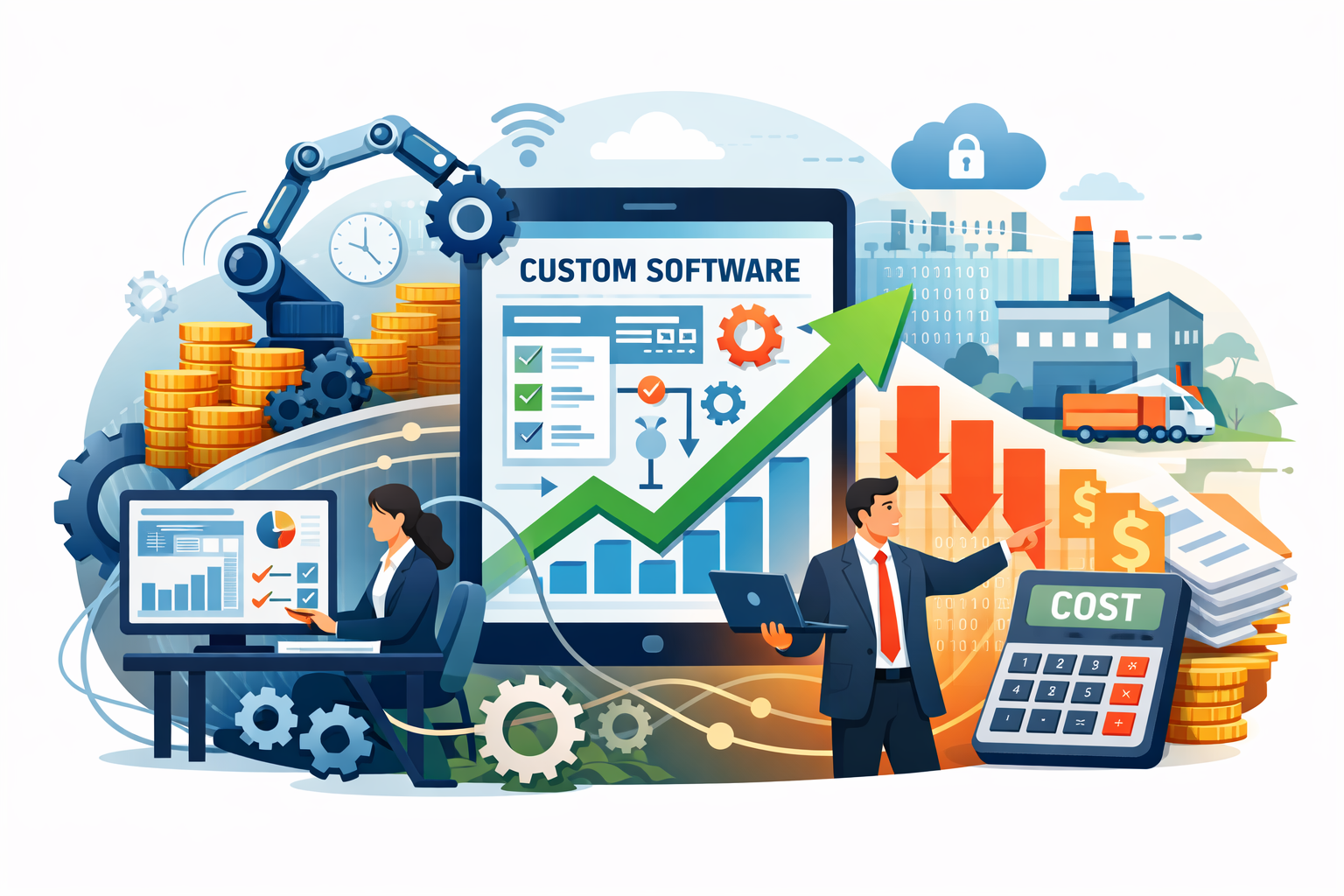
Why Custom Software Is Better Than Off-the-Shelf Solutions
Discover why custom software gives businesses more flexibility, better scalability, stronger integration, and greater long-term value than off-the-shelf solutions.
Why Custom Software Is Better Than Off-the-Shelf Solutions
In today's digital business environment, software is no longer just a support tool. It is often the engine behind daily operations, customer experience, internal organization, and long-term growth. For this reason, choosing the right software solution is one of the most important strategic decisions a company can make.
Many businesses begin with off-the-shelf software because it is fast to acquire, widely available, and often appears more affordable in the short term. However, as the company grows and its processes become more specific, the limits of generic software start to emerge. At that point, what once looked convenient can become restrictive, inefficient, and expensive.
Custom software takes a different approach. Instead of forcing your business to adapt to a generic product, it is designed around your real processes, goals, and operational needs. This is why more and more companies choose custom development when they want software that becomes a real asset rather than a compromise.
What Is the Difference Between Custom Software and Off-the-Shelf Software?
Off-the-shelf software is a ready-made solution built for a large market. It is designed to satisfy common needs across many companies and industries. Examples include standard CRMs, accounting systems, booking platforms, and team collaboration tools.
Custom software, on the other hand, is designed and developed specifically for one business. It is built to match precise workflows, user roles, internal rules, and integration requirements. Instead of accepting generic logic, the company gets a system tailored to how it actually works.
This difference may sound simple, but in practice it has a major impact on efficiency, scalability, and competitiveness.
1. Custom Software Fits Your Business, Not the Other Way Around
The biggest advantage of custom software is that it reflects the way your business actually operates. Every company has its own structure, its own processes, and its own priorities. Even within the same industry, two businesses may work in very different ways.
Off-the-shelf software usually forces teams to adapt their workflow to the product's limitations. This often means extra steps, duplicated work, manual corrections, spreadsheets used as workarounds, or staff training focused on “how to live with the software” instead of how to work better.
Custom software removes this friction. It can be built around your real approval flows, internal departments, operational logic, pricing rules, production methods, or customer journey. The result is a system that feels natural to your team and supports productivity instead of slowing it down.
2. Better Efficiency and Less Waste
Generic software often comes with many features you do not need and lacks some of the features you actually require. This creates inefficiency on both sides: your team wastes time navigating unnecessary functionality, while still having to manage important tasks outside the platform.
Custom software allows you to focus only on what creates value. Features can be designed to simplify repetitive tasks, automate manual operations, reduce human error, and improve the speed of execution across departments.
Over time, this has a measurable impact. Even small efficiency gains repeated every day across multiple employees can translate into significant cost savings and better operational performance.
3. Easier Integration With Existing Systems
Very few companies operate with a single software platform. Most businesses already use a mix of systems such as ERPs, CRMs, e-commerce platforms, accounting tools, document archives, dashboards, production systems, or internal databases.
One of the most common problems with off-the-shelf software is poor integration. Sometimes integrations are unavailable, limited, expensive, or dependent on third-party plugins. In other cases, data flows are incomplete, forcing people to copy and paste information manually between systems.
Custom software can be developed specifically to integrate with your existing infrastructure. This means data can move automatically between platforms, processes can be unified, and reporting can become much more accurate.
Instead of creating new silos, custom software can act as a bridge between the tools you already use.
4. Scalability for Future Growth
A business is not static. It evolves over time. New services are introduced, departments expand, new markets are entered, and customer expectations increase. Software that works today may become a limitation tomorrow if it was not built with growth in mind.
Off-the-shelf solutions are typically designed around standard use cases. Once your needs go beyond those boundaries, customization becomes difficult or impossible. You may be forced to upgrade to more expensive plans, buy extra modules, or replace the platform entirely.
Custom software is different because it can evolve with your company. New features can be added when needed. Existing logic can be refined. Performance can be optimized as usage increases. The platform can be extended without starting from zero.
This makes custom software a stronger long-term investment, especially for businesses with ambitious goals or complex internal operations.
5. A Real Competitive Advantage
When you use the same software as everyone else, you are working with the same limits as everyone else. Your competitors may have access to the same tools, the same dashboards, the same workflows, and the same basic automation.
Custom software gives you the opportunity to build capabilities that are unique to your business. You can create a better customer experience, support a distinctive operational model, automate a proprietary process, or give your team tools that competitors simply do not have.
In other words, custom software can become part of your competitive advantage. It is not just a system you use. It becomes part of how your company delivers value.
6. More Control and Independence
With off-the-shelf software, you are dependent on the vendor's choices. They can increase prices, remove features, change policies, limit integrations, or discontinue the product. If the software is critical to your operations, those decisions can have a serious impact on your business.
Custom software gives you much more control. You decide how the platform evolves, which features matter most, what integrations are needed, and how the user experience should work. This autonomy is especially important for businesses that rely heavily on technology in their daily operations.
Having control also means you are not constantly trying to fit your priorities into someone else's roadmap.
7. Stronger Security and Better Alignment With Your Requirements
Security is a major concern for any modern business. Off-the-shelf platforms are often attractive targets because they are used by many organizations. If a vulnerability is discovered, a large number of companies may be exposed at once.
Custom software is not automatically secure, but it gives you the ability to design security measures based on your specific environment and risk profile. Access rules, authentication methods, audit logic, permissions, and data handling can be shaped around your real needs instead of being limited to generic settings.
This is especially valuable for businesses that manage sensitive internal data, customer information, operational records, or industry-specific compliance requirements.
8. Long-Term Value Instead of Short-Term Convenience
It is true that custom software usually requires a higher initial investment. This is one of the main reasons many companies hesitate. But the real question is not just “what costs less today?” The real question is “what creates more value over time?”
Off-the-shelf software often comes with recurring subscription fees, license upgrades, add-on costs, user-based pricing, integration charges, and hidden inefficiencies caused by poor fit. Over several years, these costs can become substantial.
Custom software shifts the investment toward ownership, efficiency, and strategic alignment. Instead of paying continuously for compromise, you invest in a solution that is built for your business and can keep generating value for years.
9. Better User Adoption
Software is only useful if people actually use it well. One of the biggest reasons digital projects fail is poor adoption by internal teams. When a platform feels complicated, unnatural, or disconnected from daily work, employees create shortcuts and manual alternatives.
Because custom software is built around real users and real workflows, adoption is usually better. Interfaces can be simpler, terminology can reflect the company's language, and features can be designed around actual responsibilities instead of generic assumptions.
This leads to less resistance, faster training, and better results across the organization.
When Off-the-Shelf Software May Still Be the Right Choice
Off-the-shelf software is not always the wrong decision. In some cases, it is perfectly reasonable. A small business with simple needs, limited budget, and no special processes may benefit from a ready-made solution, especially in the early stages.
It can also make sense for temporary needs, pilot projects, or very standardized functions where differentiation is not important.
But when software becomes central to operations, customer experience, or growth strategy, the limitations of generic tools become much more serious. That is usually the point where custom software starts to make far more sense.
Conclusion
Custom software is better than off-the-shelf solutions when a business needs more than generic functionality. It offers a better fit, stronger integration, improved scalability, greater control, and long-term value that mass-market products often cannot deliver.
While off-the-shelf software may offer speed and convenience at the beginning, custom software provides something far more important: alignment with the way your business truly works and the freedom to grow without technological compromise.
For companies that want software to become a strategic advantage rather than a daily limitation, custom development is often the smartest path forward.
Related Articles
Explore more from Technology